In 1968, Sports Helped Temper a Year of Rage and Upheaval

Great article in the N.Y. Times by my friend Tim Wendel, whose new book “Summer of ’68: The Season That Changed Baseball, and America, Forever” comes out next month. Enjoy!

Pub. date: Feb. 18, 2012

By TIM WENDEL

Culture wars. Political discord. A divisive presidential campaign.

One of the reassuring aspects of history is we can often find an era, even a year, when the times were as bad or even worse than they are now.

One such year was 1968. In April, the Rev. Dr. Martin Luther King Jr. was assassinated. Two months later, Senator Robert F. Kennedy was killed. By late August, emotions boiled over on the streets of Chicago, where thousands protested what was unfolding at the Democratic National Convention. Through it all, the presidential candidates Richard M. Nixon, Hubert H. Humphrey and George C. Wallace slung the mud, and the electorate was often left disillusioned and angry.

“A year of great convulsion and heartbreak, 1968 was the closest we’ve come to a national nervous breakdown since the Civil War,” said Hampton Sides, the author of “Hellhound on His Trail,” which described the events of King’s assassination.

The traumatic year of 1968 has been analyzed and written about from all sorts of angles — political, cultural, even musical. For this was the period between the Summer of Love and Woodstock. A time when even the best band in the world, the Beatles, was shaken to its core.
But what has often been overlooked in that crucible of years was the pivotal role sports played.
In ’68, Detroit was in dire straits. Swaths of the city had burned the summer before as it experienced one of the deadliest riots in American history. Tigers outfielder Willie Horton, who had grown up in the Detroit projects, went into the streets and pleaded with his fellow citizens to stop the burning and looting, to no avail. Meanwhile, his teammate Mickey Lolich went from the pitcher’s mound to patrolling downtown Detroit as a member of the National Guard. When the ’68 baseball season was delayed by King’s funeral, the Tigers players and athletes nationwide discovered that more eyes were upon them than they had realized.
“We quickly learned that if we could pull together as a team — that meant everybody, blacks and whites — perhaps we could set an example for the rest of city,” Horton said. “There was a lot more riding on that ’68 season for us, for the city, than just wins and losses.”

In St. Louis, blacks, whites and Latinos came together to once again be the best team in the National League. Here was a ballclub that reveled in its racial diversity. A rainbow coalition well before the Rev. Jesse Jackson ever coined the phrase.


How athletes responded to the upheaval in 1968 was often human and something fans could find solace in. The Cardinals’ Bob Gibson, for example, was saddened by King’s death. He and his teammate Curt Flood greatly admired King. Perhaps as a result, Gibson did not start that season well. But when Kennedy was gunned down after winning the California primary, Gibson responded by pitching his first shutout and went on to put up a season for the ages: 13 shutouts, 28 complete games and a 1.12 earned run average. He found a way to channel his rage into superior efforts. His 17 strikeouts in Game 1 of the ’68 World Series stand as one of the most iconic performances of that season and perhaps any other period in sports. Gibson unleashed his pitches like a man on fire, battling to set right the world around him.

In comparison, Horton decided he had to rearrange his life so he was never far from home. That would seem an impossible task for a ballplayer who spends so much time on the road. But Horton, almost in a methodical fashion, made friends in every other American League city. Close enough friends that he could stop by and have dinner at their homes if he felt the need.

“That’s one way I kept going,” he said. “You had to find something when everything was falling apart around you.”

When I began “Summer of ’68: The Season That Changed Baseball, and America, Forever,” I knew I would write about two of the greatest teams in the Tigers and the Cardinals. What I did not expect to discover were athletes who were struggling like so many others in the country to find a way to move forward, to somehow come together.

Such stories were not restricted to baseball. By sitting with teammates of color at the Jets’ training table, Joe Namath helped guide them toward a Super Bowl championship that season. The Mexico City Olympics are best remembered for the raised fists of Tommie Smith and John Carlos. But those Summer Games should also be relived for the silver medal an ill-prepared Jim Ryun captured in the 1,500 meters at altitude. In basketball, the player-coach Bill Russell rallied the aging Boston Celtics past Wilt Chamberlain and the Philadelphia 76ers, then Jerry West and the Los Angeles Lakers for another championship.

“If anything, this was the biggest year in all of U.S. history,” said Robert J. Thompson, the founding director of the Bleier Center for Television and Popular Culture at Syracuse University. “So it shouldn’t come as any surprise that sports was right in the middle of the metaphoric pot of a roiling culture.”

One can argue that times are different now. The money in sports is so much more plentiful, and many athletes probably have a greater sense of entitlement. Yet every now and then, we are reminded that sports can transcend even the worst of times. From the newfound magic of Jeremy Lin to the improbable championship run of the Giants to one of the best World Series showdowns in recent memory, we gain a glimpse at the way sports can not only thrill us, but heal us, too.

Link: http://www.nytimes.com/2012/02/19/sports/in-1968-sports-helped-to-temper-a-year-of-rage-and-upheaval.html?_r=4

Fielder's Choice

Feb. 21, 2012.

More playing time for Andy Dirks

A guy I think could have a big year for the Tigers is Andy Dirks. He has spent his offsesason tearing it up down in the Caribbean league. He is the story about that http://sports.yahoo.com/mlb/news?slug=ti-brown_andy_dirks_caribbean_series_el_gringo_020712 he is a bit of a iconic figure right now in the Dominican Republic. I liked the way he played last year. He is a better outfielder than both Delmon young and Brennan Boesh. Both of those guys have a little more power than Dirks so it would make sense to play Dirks in the outfield and have Young or Boesh as the DH. He is kind of a high energy guy and he provides a bit of a spark when he plays. I am kind of scared to post that I like Andy Dirks because every time I like a young Tigers player my father in law buys me an autograph baseball of that player and they either get traded or hurt. This list of players includes Matt Joyse (traded), Clete Thomas( hurt and may never be the same again), and Ryan Perry (traded). My in laws also gave me an Andrew Miller jersey. I wish they would give me a Brandon Inge signed baseball.

LaRussa to be in Lakeland


Former Cardinals manager will help in a non-official capacity
By Jason Beck / MLB.com | 02/16/12 7:15 PM EST

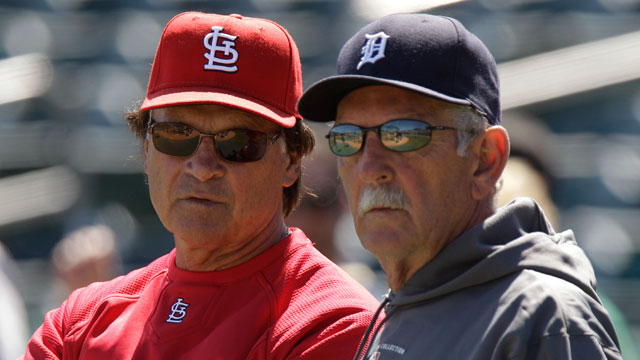
LAKELAND, Fla. -- Twelve years after Tony La Russa and the Cardinals helped give Jim Leyland a chance to stay involved in the game after Leyland's retirement as a manager, the Tigers are returning the nod.

La Russa, the longtime manager who retired after leading St. Louis to another World Series title last fall, will spend this Spring Training in camp with the Tigers in a non-uniform, non-official capacity. Leyland made the announcement while talking with reporters on Thursday after arriving at Joker Marchant Stadium.

"Tony's going to be down for a couple weeks," Leyland said. "He's going to work with Dave [Dombrowski] in the front office, and he's going over to Jupiter for a few days and then go out to Arizona for a few days. He will not be in uniform."
Tony La Russa will help old friend Jim Leyland and the Tigers in a non-official capacity this spring. (AP)

The friendship between Leyland and La Russa is well-known. La Russa hired Leyland out of the Tigers' farm system, where he had managed for more than a decade, to join La Russa's coaching staff with the White Sox in 1982. The experience helped Leyland earn his long-awaited chance to manage in the big leagues with the Pirates in 1986.

While La Russa went on to win a World Series title with Oakland in 1989, Leyland built a previously dormant Pirates club into perennial contenders, leading them to three straight National League East titles from 1990-92. Leyland went on to win a World Series with the Florida Marlins in 1997.

After Leyland resigned from the Rockies' managerial job following the 1999 season, seemingly ready to retire, he joined the Cardinals as a special assistant. Leyland regained his passion for managing, rejoined the ranks with the Tigers in 2006, and led Detroit to a World Series matchup against his former employers in St. Louis. The Cardinals won, earning La Russa his second title, then did it again this past season.

La Russa announced his retirement the day after the Cardinals held their championship parade, becoming the first manager to retire immediately after winning the World Series. He said he'd be open to another position in baseball, leading to speculation he'd join a front office, possibly back with the White Sox.

Once Joe Torre stepped down from his position with Major League Baseball to join a group bidding to purchase the Dodgers, speculation included La Russa possibly becoming Torre's successor.

One member of the White Sox front office during La Russa's time in Chicago was Dombrowski, then an assistant under general manager Roland Hemond. La Russa and Dombrowski were both let go around the same time by Hemond's successor, Ken Harrelson, and both went on to success elsewhere.

Now, more than a quarter-century later, the time with Dombrowski could give La Russa the experience to decide whether he wants to try an executive role somewhere.

Jason Beck is a reporter for MLB.com. Read Beck's Blog and follow him on Twitter @beckjason. This story was not subject to the approval of Major League Baseball or its clubs.

Brandon Inge to 2nd?

Well Jim Leyland's first "big announcement" of the spring was to let the media know that Inge approached the skipper and asked for the opportunity to start at 2nd. I happen to be a huge Inge fan (- my son-in-law happens to be a huge Inge hater. So anything positive I say about Inge he will negate.) In addition to his longevity, do the Tigers have a more loyal player? No catcher? we got Inge! help in the outfield? - we got Inge! help aty 3rd? we got Inge! Struggling at the plate -- wanna go to Toledo? we got Inge! Help at 2nd? we got Inge! Granted he is older and has never turned the double play and his bat was not too effective last year - but he definately deserves a shot. Thank goodness for the open-mindedness of Leyland. Can't wait for spring training to begin.

Zoom-Zoom’s contract details: Twins will get One Last Amazing Pitch

Since I posted this on the other blog site, which came and went as fast as Zumaya's fastball used to in 2006, I thought I'd share this again in case you missed it. Funny stuff!

From The Onion, Jan. 30, 2012

MINNEAPOLIS – Injury-plagued fireball reliever Joel Zumaya informed reporters Monday that his new $800,000 contract with the Twins obligates him to throw one last beautifully self-destructive pitch that will finally annihilate his arm forever.

“I’ve undergone dozens of surgeries and months of painstaking rehab to get my arm in good enough shape to pitch again, so that pitch is going to be absolutely incredible,” said Zumaya, whose single-pitch contract is laden with incentives for velocity, accuracy, and the horrifying sound his elbow makes when it implodes from the torque. “Bones will splinter, arteries will be spouting in all directions, ligaments will twang through the air like snapped guitar strings, and when the shock and disgust finally subside, they’ll look at the radar gun and see ‘235 mph.’ ”

Zumaya then broke his wrist clicking a pen.

Link: http://www.theonion.com/articles/joel-zumaya-agrees-to-throw-one-last-amazing-pitch,27183/